How to cut >94% of maintenance in sorting systems
How much savings potential is there in energy collector replacement alone on a sorter? A worked example on how the EAGLE Energy System adds a good 200 hours of availability.

Sample Calculation: Sorter
In many parcel sorting systems, replacing the energy collectors is one of those jobs nobody questions anymore. Changing every energy collector every three months? Not unusual. The effort never appears in an investment calculation.
Added up, the picture looks rather different. For a typical parcel sorting system with 100 master carriers and market-standard energy collectors, you easily arrive at 216 hours of maintenance work per year, purely for replacing energy collectors. That is nine full days – or 27 person-days on an eight-hour shift.
How that figure comes about, and how the EAGLE Energy System not only extends the maintenance intervals of your energy collectors but also cuts the service time itself and so raises the overall availability of your plant, is what this example works through.
The starting point: a typical parcel sorting system
Our calculation is based on a standard sorter of the kind commonly found in intralogistics:
Parameter | Example Value |
|---|---|
Operating time per week | 5 days, 24 hours |
System speed | 2.5 m/s |
Distance per week | 1,080 km |
Distance per year | 56,160 km |
Powered master carriers per plant | 100 units |
How many kilometres does a carrier cover per year?
In our example plant, a carrier travels 56,160 kilometres per year. That is roughly one and a half times around the globe, covered by a component that keeps turning its laps at high speed.
How do we get there? At 2.5 metres per second, the system covers 9,000 metres in an hour, so 9 kilometres. Running continuously over 24 hours, that comes to 216 kilometres per day. Across five operating days per week, it is 1,080 kilometres. Extrapolated over 52 weeks, this gives the 56,160 km per year.
This figure is the reference point for everything that follows. It applies per carrier, and 100 of them are powered in our plant.
How often does an energy collector need replacing?
Market-standard energy collectors reach a service life of around 13,000 kilometres in sorter operation. The EAGLE Energy Collector achieves up to 40,000 kilometres thanks to optimised carbon contacts. The replacement frequency follows from these two values and the annual distance. At 1,080 kilometres per week, 13,000 kilometres are reached after a good twelve weeks. With 40,000 kilometres, the same point shifts to roughly 37 weeks, so about eight and a half months. Four replacement rounds per year become one, and in some years two. The time between maintenance operations for energy collector replacement is therefore more than tripled.
Parameter | Market Standard | EAGLE Energy |
|---|---|---|
Energy collector service life | 13,000 km | 40,000 km |
Annual energy collector maintenance | 4.32x / year | 1.4x / year |
Effort per energy collector replacement | 30 min / carrier | 5 min / carrier |
How long does a single energy collector replacement take?
The second lever lies in the duration. A conventional energy collector change takes around 30 minutes per carrier. Fetch the tools, undo the fixings, check the position, mount, retighten, inspect.
The Quick Release System of the EAGLE Energy System allows individual energy collectors to be replaced without tools. Our engineers do it in under 3 minutes; for this calculation we assume 5 minutes per carrier.
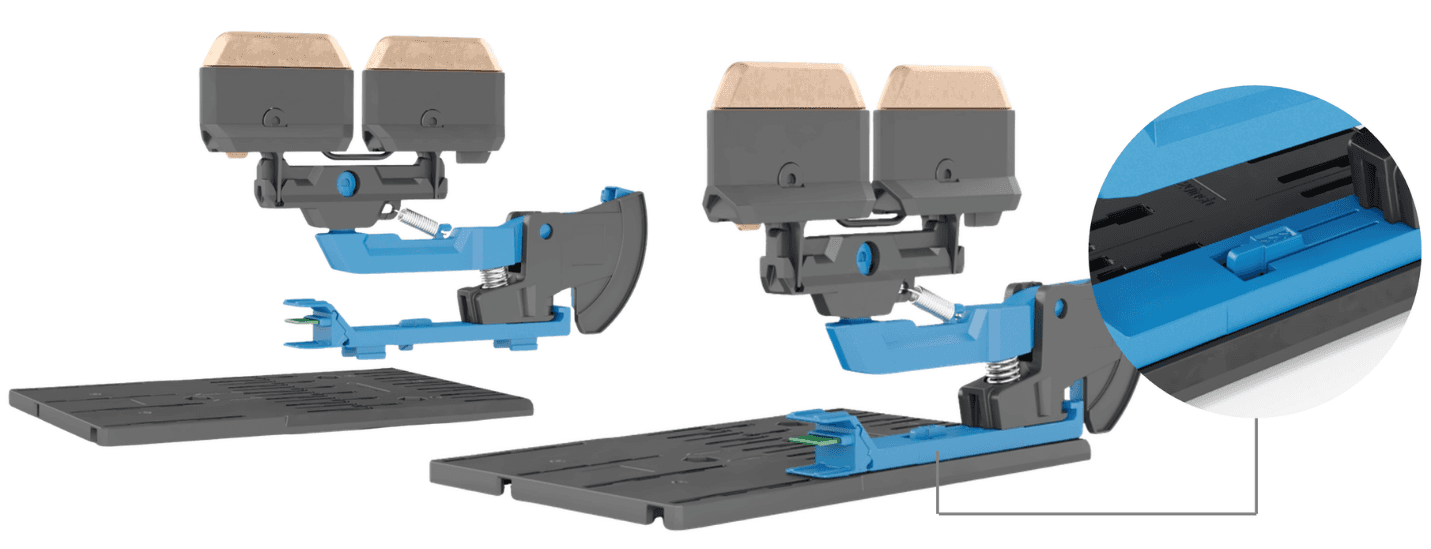
The Quick Release System of the EAGLE Energy Collectors allows a fast, tool-free replacement
Total effort per plant and year
Let us bring the three decisive variables together: replacements per year, number of carriers, minutes per replacement.
Market standard:
4.32 replacements × 100 carriers × 30 minutes = 12,960 minutes
12,960 ÷ 60 = approximately 216 hours per plant and year
EAGLE Energy System:
1.40 replacements × 100 carriers × 5 minutes = 700 minutes
700 ÷ 60 = approximately 11.67 hours per plant and year
The percentage reduction follows from the difference between the two values, relative to the starting figure:
(216 – 11.67) ÷ 216 × 100 = 94.6%

The remaining maintenance effort therefore amounts to just 5.4% of the original figure. In the unit that actually counts on the shift roster, that is 204 hours less work on energy collectors per plant and year.
What the intelligent EAGLE sensor system adds
Those 204 hours are planned time. It becomes more expensive once you add unplanned downtime.
The EAGLE Energy System monitors carbon wear to the millimetre and detects the mounting position and deflection of each individual energy collector, and of the unit itself, across three axes. An energy collector showing an unusual wear pattern is scheduled into the next maintenance window that was going to happen anyway, rather than failing in the middle of the night shift.
Current, voltage, vibration, shock loads and temperature increases are recorded and analysed by the system in real time. This allows it to detect poor transitions on the busbar and contact problems before they turn into damage to the busbar itself and bring the plant to a standstill. The data comes together in the DETO Mastergateway and is clearly presented in the EAGLE Web Interface as diagnostics, alarms and weekly reports.
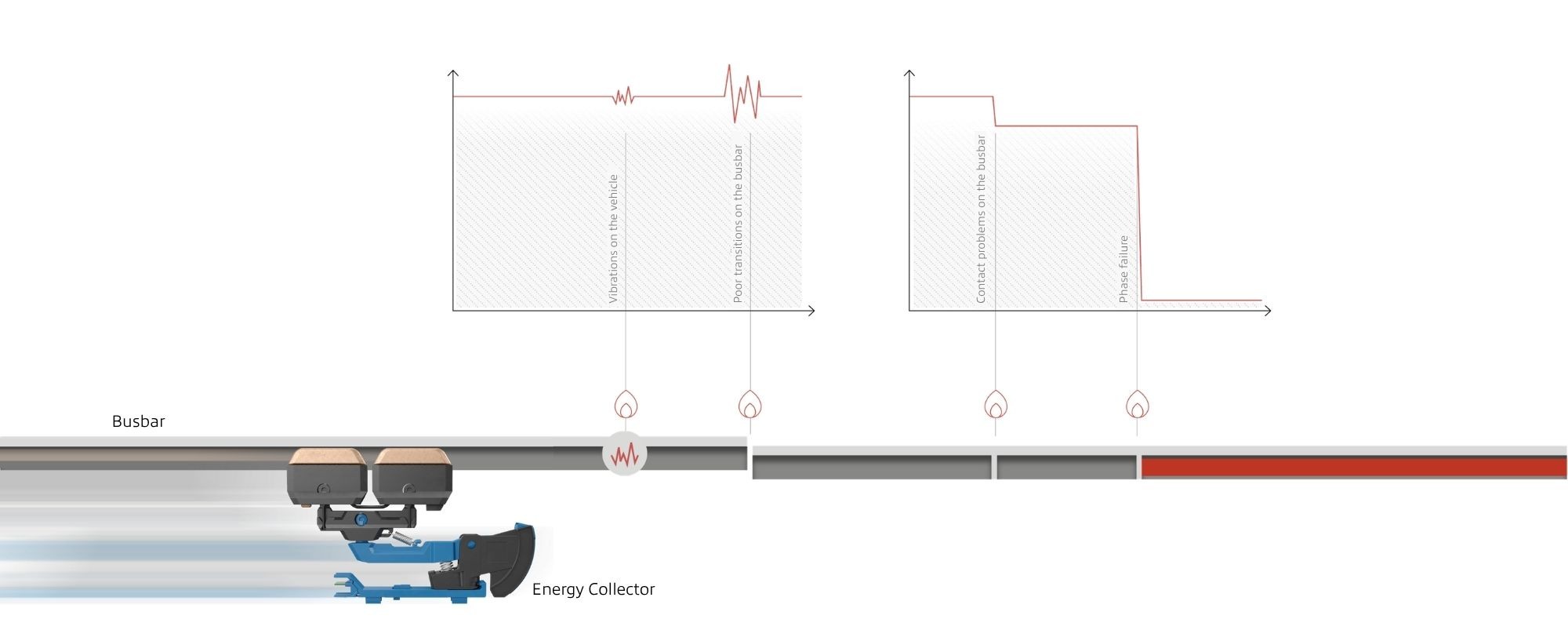
The EAGLE Energy System monitors electronic and mechanical condition data of your plant
The switch to predictive maintenance is uncritical in itself. A parcel sorting system can be converted entirely to sensor-monitored EAGLE energy transfer during the maintenance intervals that are already planned, with no mechanical modification to the plant.
The EAGLE Energy System is also available without sensors
Not every plant operator needs weekly system reports and real-time monitoring. Some simply want to spend less time at the carrier, and at the lowest possible price.
For exactly this case, the EAGLE Energy System is also available without the intelligent sensor package. The mechanical components with their long service life and the Quick Release System remain the same, and with them the two decisive levers for reducing maintenance costs.
What this variant does without is condition monitoring. Without sensors, energy collector replacement is planned by interval again rather than by condition. It remains a sensible entry point nonetheless, particularly for plants under high maintenance pressure and with a tight budget. The passive EAGLE Energy variant reduces maintenance effort immediately and can be extended later, once the condition data is needed. Which of the two variants has the shorter payback period in your plant is quickly assessed in a conversation.
The limits of this calculation
Our calculation is based on the assumptions stated above. Actual savings may differ depending on system layout, operating conditions, maintenance processes and component condition.
Specifically, the figures shift in both directions if your plant runs slower or faster, if it operates six or seven days a week, if considerably more or fewer than 100 carriers are powered, or if your existing energy collectors already achieve a longer service life than the 13,000 kilometres assumed here. The calculation method stays the same. You can work through it with your own values in a few minutes, and that is precisely why it is set out openly here.
Also excluded are material costs, disposal costs and the cost of unplanned downtime. All three point in the same direction, but are deliberately left out of this calculation so that the number of hours stands on its own.
What does this mean for your plant?
Every system has different cycle times, a different number of carriers and different maintenance windows. Talk to our experts about your specific requirements and the right configuration for your sorter, and calculate prices and payback period for new systems or retrofit projects.
Sample Calculation as a PDF
All assumptions, the complete calculation and the comparison between market-standard energy collectors and the EAGLE Energy System, clearly laid out as a PDF download: